 EN
EN ES
ES AR
AR










_converted.avif)


_converted.avif)


 EN
EN SP
SP AR
AR View on GitHub
BLOG DETAIL
Why Clean Code Architecture Matters When Choosing an Ecommerce Platform

Raja Moorthy
September 07, 2026 | 115 Views | 2 Min Read
Learn why clean code architecture matters when choosing an ecommerce platform. Discover how SpurtCommerce supports customization, scalability, integrations, maintainability, and modern marketplace requirements.
Choosing an ecommerce platform is often based on visible features.
Businesses compare product management, payment gateways, order management, vendor management, storefront design, and integrations. But there is another factor that is just as important, and often overlooked:
The architecture behind the platform.
As an ecommerce business grows, the quality of its underlying code and architecture directly affects performance, scalability, customization, maintenance, and the ability to introduce new features.
A platform may look impressive on the surface, but if its codebase is difficult to maintain or tightly coupled, even simple changes can become expensive and time-consuming.
This is why clean code architecture should be an important consideration when choosing an ecommerce platform.
What Is Clean Code Architecture?
Clean code architecture is about organizing software in a way that makes it easier to understand, modify, test, and scale.
Instead of putting everything into one large codebase where different components depend heavily on each other, a well-designed architecture separates business logic, services, data access, APIs, and other responsibilities.
This creates a more organized system where developers can work on one area without unnecessarily affecting another.
For an ecommerce platform, this becomes particularly important because the system usually contains multiple business functions, including:
- Product catalog
- Customer management
- Seller management
- Orders
- Payments
- Shipping
- Inventory
- Promotions
- Returns and refunds
- Vendor settlements
As these functions grow, architecture becomes the foundation that keeps the platform manageable.
Why Architecture Matters for Ecommerce
Ecommerce platforms are not static applications.
Businesses continuously introduce new products, vendors, sales channels, integrations, promotions, and customer experiences.
A poorly structured platform can make every new requirement more difficult.
For example, adding a new payment gateway might unexpectedly affect checkout functionality. Changing a product workflow could impact seller operations. Updating one module might create problems in another part of the system.
A clean architecture reduces these dependencies and makes development more predictable.
1. Makes Customization Easier
Every ecommerce business has different requirements.
A B2B marketplace may need customer-specific pricing and bulk ordering, while a B2C business may focus more on promotions and personalized shopping experiences.
A multi-vendor marketplace may require completely different workflows for sellers, commissions, settlements, and approvals.
A clean architecture makes it easier for developers to introduce these custom requirements without rewriting the entire platform.
This gives businesses greater flexibility to build features around their processes rather than changing their processes to fit the software.
2. Supports Scalability
Scalability is more than handling a larger number of visitors.
As an ecommerce business grows, the number of products, customers, sellers, orders, transactions, and integrations also increases.
A well-structured architecture allows individual components to be optimized and scaled according to their requirements.
For example, an ecommerce platform may need more resources for product search during high-traffic periods while other services continue operating normally.
This type of architectural flexibility becomes especially valuable for large marketplaces.
3. Simplifies Maintenance
Ecommerce platforms require continuous maintenance.
Developers need to fix bugs, improve existing functionality, update dependencies, enhance security, and introduce new capabilities.
When code is clean and responsibilities are clearly separated, developers can understand the system faster and make changes with less risk.
Instead of searching through a large, tightly connected codebase, teams can work within specific modules or services.
This can reduce development effort and make long-term maintenance more manageable.
4. Reduces the Impact of Changes
One of the biggest benefits of good architecture is separation of concerns.
Each component should have a clear responsibility.
For example, changes to a payment-related component should not unnecessarily affect product catalog functionality.
Similarly, modifications to vendor management should not break customer-facing storefront operations.
This separation helps reduce the risk of unintended consequences when new features or updates are introduced.
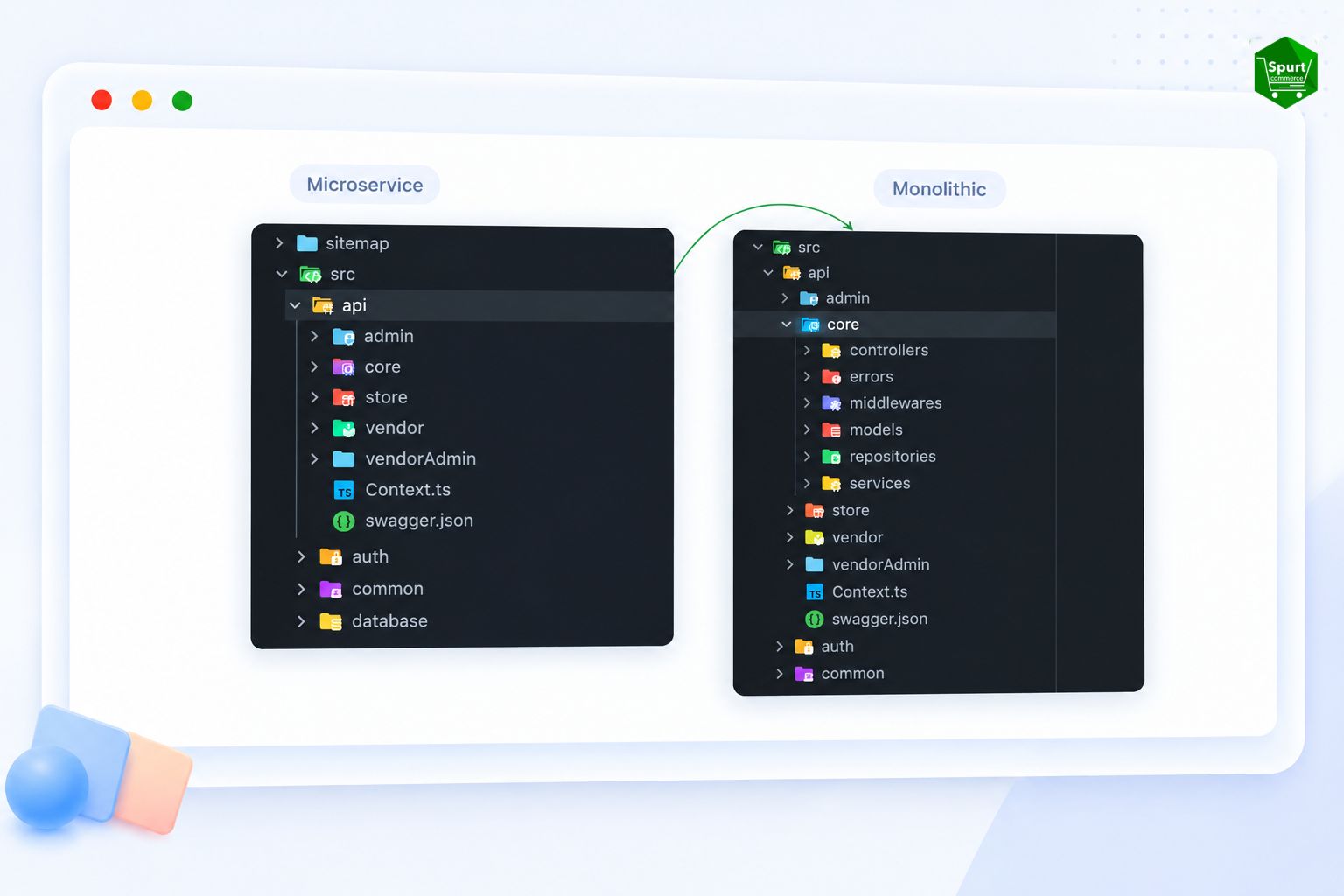
Monolithic vs. Modular Architecture
Traditional monolithic ecommerce applications often place many business functions within a single application.
This approach can work well for smaller applications, but as the platform grows, the codebase can become increasingly complex.
A modular or microservices-oriented architecture separates major business capabilities into manageable components.
For example:
Product Management → Order Management → Payment → Shipping → Vendor Management → Customer Management
Each area can be developed and maintained more independently.
The result is a platform that is easier to understand, extend, test, and scale.
Clean Architecture Helps Developers Move Faster
Good architecture isn't only beneficial for businesses—it also improves the developer experience.
When developers join a project, they need to understand how the system works before making changes.
A well-organized codebase provides clear boundaries and predictable workflows.
Developers can:
- Locate functionality faster
- Reuse existing components
- Test individual modules
- Introduce new features more safely
- Debug issues more efficiently
- Maintain the platform over time
This can significantly improve development productivity.
Better Architecture Makes Integrations Easier
Modern ecommerce businesses rarely operate with a single system.
An ecommerce platform may need to communicate with:
- ERP systems
- CRM platforms
- Payment gateways
- Shipping providers
- Accounting software
- Warehouse systems
- Marketing tools
- AI services
A clean API-driven architecture makes these integrations easier to implement and maintain.
Instead of tightly connecting every external system to the core application, businesses can create well-defined integration points.
This provides greater flexibility when introducing new technologies or replacing existing services.
Architecture Is Important for Multi-Vendor Marketplaces
Architecture becomes even more critical when building a multi-vendor marketplace.
A marketplace needs to support multiple stakeholders and complex workflows.
Sellers need to manage products and orders.
Customers need a smooth shopping experience.
Administrators need control over vendors, commissions, settlements, and platform operations.
A scalable architecture helps keep these responsibilities organized.
This allows marketplace businesses to add new vendors, features, integrations, and workflows without continuously increasing technical complexity.
How Spurtcommerce Approaches Ecommerce Architecture
Spurtcommerce is designed for businesses that need more flexibility than a basic ecommerce solution can provide.
Its architecture is designed to support modern ecommerce and marketplace requirements while keeping different business capabilities organized.
SpurtCommerce supports capabilities across areas such as:
- Product management
- Customer management
- Vendor management
- Order management
- Payment processing
- Shipping
- Returns and refunds
- Vendor settlements
- B2B commerce
- B2C commerce
- Multi-vendor marketplaces
This architectural approach provides a strong foundation for businesses that expect their ecommerce operations to evolve over time.
Open Source + Clean Architecture: A Powerful Combination
Open source gives businesses access to the source code.
Clean architecture makes that source code easier to understand and extend.
Together, they provide businesses with greater control over their ecommerce technology.
With an open source platform such as SpurtCommerce, businesses and development teams can examine the platform, customize existing functionality, build new capabilities, and integrate it with their existing technology ecosystem.
This is particularly valuable for businesses with unique workflows or long-term customization requirements.
What Should Businesses Look for in an Ecommerce Platform?
Before selecting an ecommerce platform, businesses should look beyond the feature checklist.
Consider questions such as:
Is the architecture modular?
Can individual components be changed without affecting the entire platform?
Is the code maintainable?
Can developers easily understand and work with the codebase?
Does the platform support APIs and integrations?
Can it connect with your existing business systems?
Can it scale?
Will the architecture support increasing customers, products, orders, and vendors?
Can it be customized?
Can your development team build features specific to your business?
Is the platform future-ready?
Can you introduce technologies such as AI, automation, headless commerce, and new integrations as your business evolves?
These questions can be more important in the long run than simply counting the number of built-in features.
Building for Today and Tomorrow
An ecommerce platform is a long-term technology investment.
The platform you choose today may eventually manage thousands of products, multiple sellers, large order volumes, complex integrations, and millions of customer interactions.
Choosing a platform with a clean and scalable architecture helps prepare your business for that growth.
Rather than repeatedly rebuilding the system as requirements change, businesses can evolve the platform gradually.
Conclusion
The visible features of an ecommerce platform are important, but the architecture behind those features determines how effectively the platform can evolve.
Clean code architecture provides the foundation for customization, scalability, maintainability, integrations, and long-term innovation.
For businesses building B2B, B2C, or multi-vendor ecommerce solutions, choosing a platform with a well-structured architecture can make a significant difference as the business grows.
With Spurtcommerce, businesses get an open source ecommerce platform designed to support modern commerce requirements while providing the flexibility needed for customization and future growth.
Don't just choose an ecommerce platform based on what it can do today. Choose one based on how well it can evolve with your business tomorrow.

 Available